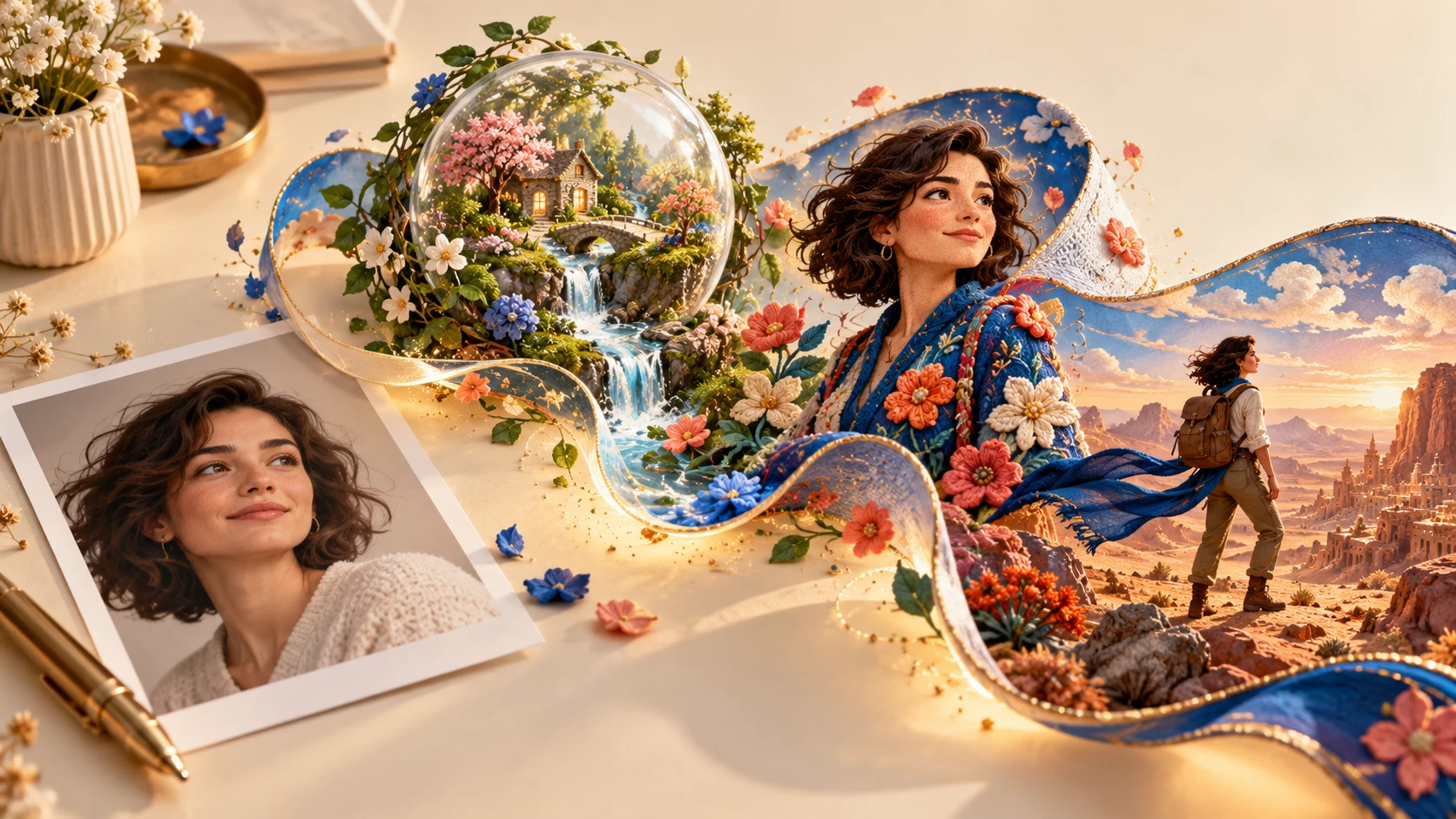
What would you look like as a collectible toy, a science-fiction robot or the star of an imaginary film? A photograph and a clear creative brief are enough to start exploring those ideas.
The interesting part is choosing a direction and seeing how far you can take it. Here are six starting points, with prompts you can adapt for a personal project, a playful social post or a visual mood board.
Before you upload your photograph
Choose a sharp image in which the subject is easy to see, and use a photo you have permission to edit. In an image-capable ChatGPT conversation, upload it and explain what should stay recognisable. These are creative instructions, rather than secret commands or guaranteed effects.
Replace the details in square brackets before submitting each prompt. If preserving your face matters, say so explicitly and check the result: a request to preserve a likeness does not guarantee an exact match.
1. Put yourself on the toy shelf
A boxed figure works best when its accessories tell a small story. Think of three objects someone would associate with your work or favourite hobby.
Use my uploaded photo to design a collectible figure in retail-style display packaging. Retain my distinctive facial features and hairstyle. Add [three accessories], a [colour] backing card and the character name [name]. Show the full box against a clean studio background, with realistic moulded plastic and soft reflections.
2. Invent a souvenir banknote
Make this an obviously fictional keepsake: invent a currency, use an original layout and give it a playful purpose.
Create an imaginary souvenir banknote using my portrait as the central illustration. Call the currency [invented name] and use [colours], decorative borders and original symbols connected with [hobby or theme]. Clearly include FICTIONAL SOUVENIR. Do not imitate an existing banknote.
3. Meet your robot alter ego
For a mecha concept, describe the armour and the environment together. A low viewpoint and tiny surrounding buildings can help communicate scale.
Reimagine the person in my reference photo as a towering armoured robot. Echo their recognisable features in the helmet and use [colours] for the armour. Add intricate mechanical joints and subtle glowing panels. Show the robot in a futuristic city at twilight, viewed from street level with cinematic lighting.
4. Build a world above the clouds
A floating island gives you room to experiment with atmosphere. Decide whether your world should feel peaceful, mysterious or adventurous.
Place the person from my uploaded photograph on a small floating island high above the clouds. Preserve their recognisable appearance. Include a winding path, lush plants, a waterfall disappearing into mist and [one personal detail]. Use warm early-morning light and a wide fantasy-landscape composition.
5. Create a soft toy character
Focus on the features that will survive simplification: a hairstyle, glasses, clothing colours or a favourite jacket.
Transform my reference photo into a handmade plush character. Keep the distinctive hairstyle, [clothing detail] and overall personality, simplified into rounded proportions. Use soft fleece, embroidered facial details and visible seams. Show the finished toy on a pastel background with gentle studio lighting.
6. Star in a fictional film
Choose the genre before the scenery. A comedy poster and a mystery poster need different expressions, colours and lighting.
Design an original [genre] film poster featuring the person in my photo as the lead character. Set the scene in [location] and use [mood] lighting. Keep the face recognisable and leave room for the title [title] and tagline [tagline]. Use a portrait layout with a clear focal point and minimal lettering.
Improve the result with one focused change
After the first image, identify the most useful adjustment. Try “keep the composition, but simplify the background” or “keep the outfit and make the lighting warmer”. Changing one thing at a time makes it easier to judge what helped.
Check faces, hands, lettering and small objects before sharing. For a polished title or brand name, adding the final text in a design editor may be easier. If the image is for social media or a website banner, include the intended shape in your brief from the start.
Get the full collection of 100 ideas
These six examples are a taster of my 100 Creative AI Image Prompts guide, covering transformations, art styles, miniature scenes and advertising concepts.
Enter your first name and email on the Marketing by Spencer form to receive the PDF. Start with one idea you like, personalise the details and keep the prompt that produces your favourite result.
Want more useful everyday prompts? Read my four ways to get clearer answers from ChatGPT.